Home > Vintages and Regions > Bordeaux > Bordeaux 2005 > Four Years: Introduction
Bordeaux 2005 at Four Years: Introduction
Bordeaux 2005
En primeur
At Two Years
At Four Years
Introduction
It might seem somewhat superfluous, maybe even something of a folly, to return to reassess this vintage. After all, surely by now every possible consumer of these wines is aware that this year is a strong contender for vintage of the century if not vintage of the millennium, as evinced by the fashion in which the prices of many of the wines have rocketed skywards since their release in 2006? And surely everybody who will buy 2005 has already bought, especially as the likelihood that prices will continue to rise in coming years is high? Should we not let the wines rest on their laurels, or preferably in our cellars - should we be so lucky - until a time when they will be ready to wake from their slumber and reveal all the joys of maturing claret from a great vintage? Perhaps, but perhaps not! I myself don't feel such an approach would be a sage one; vintages need to be revisited from time to time, to verify that our early assessments are still valid, or indeed, where appropriate, to correct them, unless we are the sort of taster who calls every bottle right, every time (not me, but such claims are made by others). And of course we may discover good bottles hitherto unnoticed, and thus realise that there is still relative value in the vintage, especially useful information for those looking for labels perhaps of less appeal to investors but which provide the rest of us with some good drinking. And finally, if the wines turn out to be as good as we hoped they would be, then we can begin to look to see when we should be drinking them.
It is perhaps too early to be looking to open and drink these wines, they are still very young, but it is certainly not too late to revisit and reassess the vintage, and look for the good (and good-value) bottles. And so it was that during the first week of November I caught an early flight down to the Institute of Masters of Wine in London for the annual claret tasting, an event which always features the vintage that has just celebrated its fourth birthday. My slate was clean, as I have already extolled during my introduction to the UGC tasting of 2007 Bordeaux; other than a few snippets of information picked up from my occasional browsing of various webfora I haven't really revisited this vintage since I last tasted the wines two years ago. And so I would hopefully be free of any major bias or preconception during the tasting, other than the seemingly universal understanding that this is a great vintage. So I was expecting great things....but which wines would truly shine on the day, and which would appear to have a somewhat duller hue?
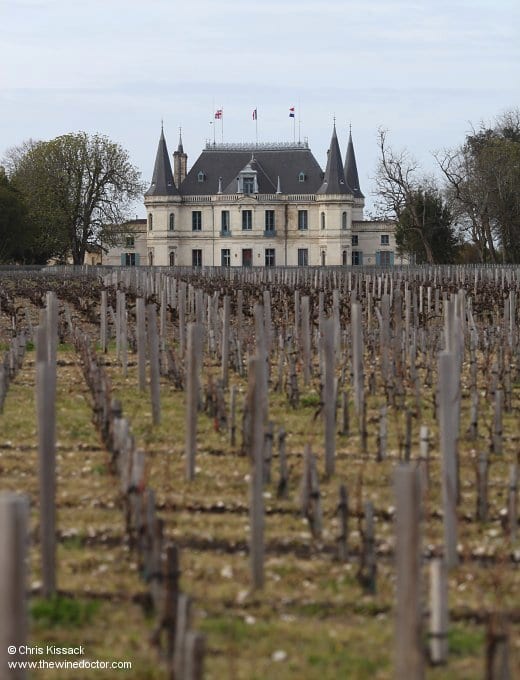
Vintage Recap
There is an easy sound-bite for 2005; warm and dry, for summer and harvest. Any more detailed explanation provides us with mere nuances, nevertheless these nuances can sometimes be very informative. And so it is worth spending a few moments reflecting on the characteristics of the vintage, and just why there were so many broad smiles in the vineyards and cellars of Bordeaux at harvest time.
Although the dry weather
in 2005 brought
near-drought conditions to the region the wines were not so stressed as to
impair photosynthesis or fruit development to any major degree. The process of
flowering and fruit-set had been fairly unremarkable, and so the ripening swept
through the vineyards in a uniform fashion, unhampered by rain and rot. The skins
were ripe and thick, giving the wines a vibrant colour and a backbone of
tannin which will set the best up for many decades of cellaring. The
berries were small, testament to the dry weather, giving a good solid to liquid
ratio and thus a good concentration of sugars and flavour.
I remember harvest-time well, experienced vicariously through the internet chatter and also one or two Bordeaux-based blogs, that of Palmer being the most memorable (and not only because commercial director Bernard de Laage de Meux's team chose to advertise the blog's creation on Winedoctor). The Bordelais were ecstatic, the musts were perfect, and great wines were on the cards. Events since then seem to have borne out those early reactions; tasted en primeur the wines were fabulous, and as I have described above the prices quickly came to reflect this. For those following the story of 2009, the vintage that coincides most closely with the date of publication of this article, this must seem like a very familiar story. Bordeaux proprietors are already questioning which of the two will turn out to be the greater with time. Perhaps 2009 will be the vintage of the quintillennium?
Tasting the Wines, Four Years On
On the whole I am happy to say I was not disappointed with this tasting; there were many superb wines on show here. There was of course not universal success, and a handful of wines showed a little coarseness of tannin, or a confected edge to the fruit, but most tasted wonderful, and even those that failed to exhibit the finest of characteristics still have much potential, as the tannins fade and the flavour profile develops with time. Perhaps not everyone was so impressed though, as during the tasting I did overhear some criticism of the wines that was more wide-ranging and cutting than my own comments; the tannins aren't silky enough...the fruit very hard....the structure too coarse, and so on. Is it fashionable, I found myself wondering, to knock such great wines because they do not quite attain perfection? How good does a wine have to be before we should praise it? Whatever the answer, surely these wines have reached that point?
Sticking with gossip and tittle-tattle for a moment, may I digress? In almost the same breath, some critics of 2005 expressed the thought that the 2007 vintage, recently experienced by many tasters present at this tasting at the recent UGC event, was under-rated and even over-criticised; after all, they opined, they will be lovely to drink in restaurants in the next few years. I have some sympathy with that latter sentiment, but my main problem with that vintage is - as I have already extolled - the placing of a value on the wines that far exceeds their worth as conveyors of pleasure to the eventual consumer. No, give me 2005 any day...provided I can afford it of course.
I present my notes from this tasting in three instalments, not quite in the order in which I tasted them. Keen to ensure I did not miss out on the grandest wines I tasted the first growths and their right bank equivalents first, followed by the second growths, and then a mix of the remaining wines. This is not my usual pattern of tasting, as I usually follow a more regional scheme, tasting within commune or appellation, but it was a plan that worked well, and one that I will follow again in future I think. A small handful of wines disappointed, at the second growth level and below, and where possible I returned to these wines later in the day, so a few wines were tasted twice. The tasting was not blind, and my notes are presented as written at the time of tasting. (17/11/09)
