
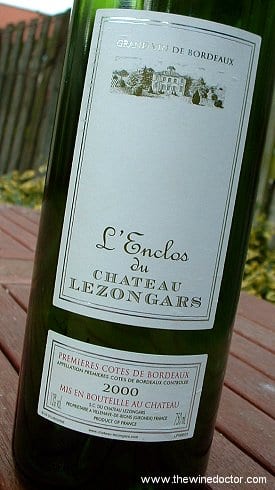
L’Enclos du Château Lezongars 2000
This week, one of several bottles from Château Lezongars tasted this weekend. The wines, which are bottled (in this vintage at least) under the Premières Côtes de Bordeaux appellation, are made under the supervision of Philip Iles, owner since 1998. More on Château Lezongars when I write up the wines in full later this week; for the moment I would rather draw your attention, if I may, to the appellation, which is one you won’t be seeing much more of in the future.
From the 2007 vintage the four Bordeaux regions of Premieres Côtes de Blaye, Premieres Côtes de Bordeaux, Côtes de Franc and Côtes de Castillon have been amalgamated into one sweeping Bordeaux appellation, named the Côtes de Bordeaux. Three of these appellations lie firmly on the right bank, these being the Premieres Côtes de Blaye which lies downstream of the more famous St Emilion and Pomerol, and upstream the Côtes de Castillon, which lies on a limestone plateau contiguous with the plateau of St Emilion, and the Côtes de Francs. The fourth lies between the two great rivers of Bordeaux, with the Premieres Côtes de Bordeaux sandwiched between the Entre-Deux-Mers appellation and the Garonne. One other obvious candidate, the Côtes de Bourg, has not applied for the new appellation, because of labelling restrictions it seems. The regions will be allowed to utilise regional names – Blaye, Francs, Castillon and Cadillac – to indicate origin, but the Bourg vignerons wanted more flexibility in use of the appellation, and so have stayed on the outside – for now.
Having glanced at the INAO regulations there seems little to distinguish this new appellation as anything special. There are obligatory requirements for vines planted after August 2008 although they are hardly stringent, with a minimum planting density of 4500-5000 vines/ha depending on the region; my impression is that most newly established vineyards in Bordeaux these days are planted somewhere between 6000 and 10000 vines/ha anyway. Yields kick off at 53 hl/ha for generic Côtes de Bordeaux, and for wines with a regional indicator 50 hl/ha for red (all four regions), 60 hl/ha for white (Blaye and Francs) and 37 hl/ha for sweet wines (Francs only). These numbers aren’t anything unusual, and are of course only starting points as they may be adjusted annually, using the new Rendement Moyen Décennal, a system whereby limits on yields may be adjusted from year to year depending on the weather, provided that a ten year average remains below the upper limit. This system replaces the Plafond Limite de Classement, which took no account of the quality of the vintage, but usually allowed a harvest significantly larger than the published maximum yield for the appellation (20% extra would have been typical). So I would imagine that the advantages of joint marketing, label simplicity and firming up the association with Bordeaux (the words Premieres Côtes de Blaye, for instance, don’t inform the consumer that this is a wine of Bordeaux) will be the main advantages in this new appellation.
For the moment, though, this is a chance to taste what is possible in one of these outgoing appellations when the desire, passion and commitment is there. The 2000 L’Enclos, from Château Lezongars, is my Weekend Wine. A Premières Côtes de Bordeaux, this particular cuvée shows plenty of aromatic promise on the nose, which opens out after a very short time in the glass to give some finely perfumed fruit, violets, bonfires and smoke. Later it takes on a more meaty, rusty, dark and characterful style. It is certainly delightful. A fine palate, carrying some weight, but quite a polished character, with some substance underneath, backed up by ripe tannins. Despite the elegant perfume there is some juiciness to this wine, a delicious, fresh, oak-free character. Sappy and just a little tannic still on the finish, savoury and nicely composed, with good structure underneath the floral fruit, this is a wine that will continue to drink well and perhaps improve for several years yet, although I wholeheartedly recommend tucking in now if you have any. This is really good stuff. 17+/20 (23/2/09)
Find L’Enclos du Château Lezongars 2000 on Wine Searcher: 
Find all Château Lezongars wines on Wine Searcher: