Home > Vintages and Regions > 10, 15 & 20 Years On > Ten Years On: 2001 (part 2)
Ten Years On: The 2001 Vintage
Ten Years On: 2001
Notes from a 2001 tasting at 10 years:
Part 1: France & Italy
Part 2: Germany & Spain
Other relevant tastings:
Continuing on from my account of the wines from France and Italy in part one, we now come to Germany and Italy. Both were blessed in 2001; this was an excellent vintage for the Mosel (and other German wine regions) as it was in Spain, specifically in Rioja. I am aware there is a lot more to Spain than Rioja, of course, but other than occasional forays into the wines of Navarra and Murcia, and the odd glass of Vega Sicilia and Tio Pepe En Rama here or there, it is not a wine country I have any great familiarity with. Tackling it from scratch would be a Herculean task, and so my best wishes go to Neal Martin who is taking on this assignment for the Wine Advocate following the departure of Jay Miller at the end of 2011.
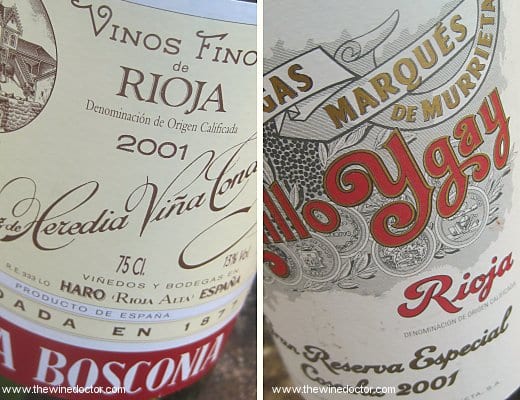
My focus on Spain was very narrow, and this tasting features just four wines from Spain. One, the Campo Viejo Rioja Gran Reserva, was a crime against Rioja and wine as a whole. I have to confess it was not a wine I acquired for the purpose of this tasting, but the bottle came into my hands by serendipitous (or perhaps not so serendipitous?) means just a few weeks beforehand. One, the Fernando Remírez de Ganuza Fincas de Ganuza Rioja Reserva, was attractive although in a rather glossy, 'international' manner. It made for an appealing mouthful, but seemed to say little of Rioja to me; this is exactly the sort of wine I am trying not to buy these days. Thank heavens for Lopez de Heredia and Marqués de Murrieta, especially their Bosconia and Castillo Ygay cuvées respectively. I confess, though, that in each case this was clearly infanticide; should you have any of either of these wines, keep them both locked up for the foreseeable future.

Moving on to Germany, happily I do have a slightly broader and deeper knowledge of this nation's wines. Although to be fair, you do not need to be an expert to know that 2001 was one of the greater vintages for Germany in recent decades. There have in fact been many fine vintages since, but 2001 remains one of the best. Despite this Germany, rather like Sauternes, has been much maligned over the years; the wines just aren't sexy, alcoholic and oaky enough for some. Thank heavens for traditional, balanced, terroir-focussed and acid-rich wines such as these; they are breath-taking to taste and drink. Those tasted here were, on the whole, no exception.
I'm not sure a run-down of the wines tasted here will add anything, as my notes will speak for themselves, and some generalisation is valid instead, as the wines showed unprecedented quality and consistency as a group. I looked at a selection of wines from some top names, including Fritz Haag, Joh. Jos. Prüm and Maximin Grünhäuser, and across the board the wines were of an extremely high standard. This is a vintage imbued with vibrant structures, sometimes the most intensely sparkling minerality, and deep, rich flavours. At ten years of age the wines, from kabinett through spätlese to auslese, all showed great purity and youthful vigour. These are wines which, especially at higher levels of the prädikat, should drink well for decades to come.
My notes on the wines of Germany and Spain are below. See part one for my notes on the wines of France and Italy. (28/12/11)
2001 Germany & Spain - Tasting Notes
Tasted in December 2011. Click
to locate stockists.
Markus Molitor Zeltinger Himmelreich Riesling Spätlese 2001:
An appealing depth of colour, and aromatically we have scents of very sherbetty
fruit, partly zesty citrus, partly reminiscent of exotic stone fruit, moving
away from white peach towards the mango end of the spectrum. It has great
intensity, and that sherbetty-minerally-rocky edge lends it an extra very
welcome dimension. The previously noted sulphur is nowhere to be seen. The
palate is appropriately rich and fleshy, but with appropriate acidity, backed up
by a pithy and zesty fruit character, but more than anything it has a firm,
scratching, minerally presence. A rich, full-bodied and imposing style which
eases confidently into a bold, sweet, lip-smacking finish. A very appealing
wine, perhaps stronger on orange and tropical fruit than filigree elegance,
but nevertheless nicely imbued with minerally character, gritty structure and an
admirable length. 17/20
AP number: 2 576 609 05 02
![]()
Fritz Haag Brauneberger Juffer Sonnenuhr Riesling Spätlese 2001:
A good depth of hue here. The nose is pure and unsullied, full of precise lime
fruit, with mixed citrus notes, bright and fresh apples and some sweet peachy
elements. It is all very primary and fresh still, despite this wine's ten years;
I don't see anything here to suggest maturity, no petrol or mealy elements, just
young, fun, lightly sherbetty fruit. Lovely depth on the palate, although it
still has a bright and almost floral character in keeping with the youthful
aromatics. Lightly fleshy, but pure and citrusy with it, with an appropriate
fleshy residual. A nice citric cut coming through in the finish, with a
slatey-sherbetty bite here. There's also even a little carbon dioxide spritz
left here, with a few bubbles gathering on the inside of the glass to match this
impression on the palate; an important factor in this wine's Peter Pan
appearance, perhaps? Delicious wine, just brimming with great long-term
potential. 18/20
AP number: 2 577 050 7 02
![]()
Fritz Haag Brauneberger Juffer Sonnenuhr Riesling Auslese Fuder 10 2001:
This is the first of my bottles; how did I manage to leave them so long? What is
most striking here is the purity, definition and expression of the wine. It is
by no means a quiet or retiring style, and yet neither is it remotely vulgar or
obvious. The nose sings of sweet but crunchy eating apples, along with citrus
peel and underneath a smoky, slight reductive character, with very faint rubber
and mineral elements which - in the case of the former - is sufficiently subtle
to still be very appealing. There is also a fleeting glimpse of pineapple which
is a little unexpected. Beautifully composed on the palate, fleshy and very much
an auslese, but with all the bright vigour we should find, almost sherbetty
intensity of minerality along with some pithy orange elements, blackcurrants,
and a little seam of slightly bitter phenolics. Later on, there is a note of
caramel-toffee twist behind the lime intensity. In the finish, it is sweet,
long, refreshing and just full of zip. Great substance here too. Delicious and
just loaded with potential for the years ahead; it should be - this tastes as
fresh as if it were made yesterday. And just 7.5% too. 18.5/20
AP number: 2 577 050 10 02
![]()
Gunderloch Nackenheim Rothenberg Riesling Spätlese 2001:
A good colour in the glass but it is aromatically and then most certainly on the
palate that this wine really impresses. It bears scents of vibrant lime and
mealy, petrol-tinged fruit, but it remains more vivacious than evolved. And the
palate is just so lovely, with explosive volcanic-sherbetty minerality that
scratches across all the surfaces of my mouth such is its deep intensity. It
seems to be imbued with essence of rock, powdered down and added to the wine in
the vat maybe, supported by a sweet richness and delightfully grippy-pithy lime,
red-skinned apple and mango fruit. Brilliant acidity too, as you might expect.
Although you might not think it possible, in the finish the thick seam of
minerals comes to dominate even more, lingering on and on long after the fruit
has faded, This is truly remarkable wine. 18.5/20
AP number: 4 379 904 306 02
![]()
Gunderloch Nackenheim Rothenberg Riesling Auslese 2001:
A vibrant golden hue to this wine. An open and expressive nose, honeyed fruit,
taking on a slightly sweeter, more tropical style than the predominant citrus,
although this does come in from behind, with notes of satsuma zest and limes.
Fabulous weight, with impressive juicy citrus acidity at its core, with a very
exuberant, rich, honeyed fruit character on the palate, cut through with an
amazing minerality. Great acidity too, precise although quite well hidden within
the voluptuous weight of fruit, coming more to the fore at the end, along with
that seam of minerals, which lingers on and on through the finish. Incredibly
long. Mouth-watering, citrus-juicy, but there is also a fine mealy richness
interwoven with the succulent fruit, giving the wine a firm savoury vein which
complements the minerally weight. It seems more gritty here, and there is
perhaps a touch of petrol too. But this is still a wine of dense, fruit-laden
minerality. Excellent. 18/20
AP number: 4 379 904 307 02
![]()
Joh. Jos. Prüm Wehlener Sonnenuhr Riesling Kabinett 2001:
Perhaps a little more colour here than when tasted last year. The nose is
enticing, with a fine exotic tropical fruit depth here, with a complex intensity
that brings an almost chewy, mealy sense to the fruit profile. This doesn't seem
so purely bright now, but is rich as well. although it still has all those
apple, lime and flower petal characteristics. A beautifully fleshy start to the
palate, perhaps a little too rich for some lovers of true kabinetts who
might prefer a more laser-like cut. This exotic character carries through onto
the palate, with pineapple, honeydew melon, candied lemon and also shifting
towards a petrol element as well. Also a touch of honeyed sweetness in the end,
which is soft and very long, Elegant, seductive and remarkably deep. 18/20
AP number: 2 576 511 12 02
![]()
Joh. Jos. Prüm Wehlener Sonnenuhr Riesling
Spätlese 2001: A clear green-tinged hue, and with the suggestion of a spritz, as there are quite
a few residual carbon dioxide bubbles clinging to the inside of the glass here.
A lovely purity on the nose, very expressive and yet bright, fresh and defined,
with lime fruit and blackcurrant leaf. There is a suggestion of mineral crunch
to it, but the previously noted sulphur has now dissipated. The palate has
heart-stopping definition; what I really love about Prüm is that the wines
combine weight with grand definition and vivacious, minerally, sherbetty, acid
framed lift; this spätlese is no exception. It has such vigour and lift
on the palate, and yet this is communicated with delicacy rather than power or
form. No longer awkward, instead beautifully defined and rich. This is very fine
indeed. Approachable now such is its mealy sherbetty delight, but as I have
noted previously it should go for years and years. Fantastic wine. 18.5/20
AP number: 2 576 511 15 02
![]()
Joh. Jos. Prüm Wehlener Sonnenuhr Riesling
Auslese 2001: A clear green-tinged hue, and just like the spätlese this shows a light
application of carbon dioxide bubbles around the inner surface of the glass.
Unfortunately it still reeks of typical Prüm sulphur at this stage, with struck
match and mothball characteristics dominating at present. I described it as a
‘faint tinge’ in 2007 but perhaps I was being kind; it certainly isn’t faint here. There is still a bright, vivacious minerality
underneath it though, along with little notes of seashell and seaside ‘ozone’.
Lovely weight, although it feels light-footed and gentle and harmonious. Not
intensely sweet, not overtly sweeter than the spätlese in fact, although
there is a beautifully fleshy polish on the palate with a very harmonious
structure. Lovely vibrancy on the finish, which is fresh and long. It still
needs time, this one; and it will drink well for decades I am certain. 18.5/20
AP number: 2 576 511 19 02
![]()
Maximin Grünhäuser Abtsberg Riesling Kabinett 2001:
One of those bottles which has undeniably leaked, with the cork fully soaked and
with a sticky crusting beneath and around the capsule, and yet the condition of the
wine within is beautiful. A fairly richly coloured, shimmering straw hue with a tinge of green in
the glass, the aromatics are precise and powerful, with zesty lime pie laid over
a fine minerally backbone, with some faint elements suggestive of petrol. Nicely
substantive at the start on the palate before revealing a spiky structure, prior
to a remarkable softening and relaxation through the midpalate, the wine here
suddenly opening out to envelop every facet of every taste bud, morphing into
something creamy and rich. The acidity (which seemed so flat a year ago)
persists, keeping the palate focused, helped by a fine mineral character which
cuts through the deliciously defined flesh (perhaps too fleshy for a kabinett
- although I adore it) like the edge of a sharp flint. And then in the finish it
is relaxed, slightly mealy, sappy, complex. And long too. Delicious wine; so
much more here than I expected when this went through a rather soapy, perfumed,
chalky phase 4-5 years ago. 17.5/20
AP number: 3 536 014 14 02
![]()
Maximin Grünhäuser Abtsberg Riesling Spätlese 2001:
A very clean, bright, pale green-straw hue. The nose is very minerally, with
elements of chalk and talc, with a perfumed style. There are aromas of green
olives, lime, green apple-skin, peach with a lightly perfumed edge, and a sea of
petrol which despite being overtly expressed does still allow the other aromas
to shine through. The palate is vibrant and exciting, showing an immediate
flourish of acid at the very start, with a little tingling sensation. Fleshy
substance, sweeter and limpid through the middle, taking over from the
acid-fresh start, more soft and flattering towards the end, with some subtle
citrus pith giving some grip at here. Bright and reserved, with just that bitter
lime pith bringing some punchy structure. Delicious. 17.5/20
AP number: 3 536 014 18 02
![]()
Maximin Grünhäuser Herrenberg Riesling Spätlese 2001:
A vibrant and aromatic nose here, stuffed full of blackcurrant leaf, lime
sherbet and apple skin. It suggests crumbly, volcanic minerality as well, an
aroma that goes hand in hand with that sherbetty element I find. Full and
displaying its residual sugar very well on entry, but with more savoury, mealy
elements coming in on the midpalate. Citrus fruits, blackcurrant leaf like the
nose. Super balance, fleshy but full of vigour and energy underneath this, with
a fine and precise acid core. Fine weight and substance, promising, but still
very primary with minimal evolution; there is a little petrolly scent, but it
does not feel so developed otherwise, and is still dominated by youthful vigour.
This needs time, and should easily go another decade. 17.5/20
AP number: 3 536 014 16 02
![]()
Maximin Grünhäuser Herrenberg Riesling Auslese 188 2001:
Crystal clear, with a good golden hue. The nose has some evolved, mealy,
lime-oil and petrol elements, but more than that the aromas here are still very
rich and fruit dominated, with a firm blackcurrant leaf and raspberry leaf style
at first, later notes of pear skin and apples. Fleshy and very broad at the
beginning on the palate, showing plenty of nascent puppy fat still, even after
ten years. In the midpalate though, there is a greater sense of energy, with a
volcanic style of minerality, subtle but certainly there, sometimes giving a
real spice to the endpalate, and buoying up that mealy richness suggested by the
aromatics. This is very long. It seems, despite those moments of energy, much
more relaxed and open than I recall from my last tasting, when I felt it was
much more tightly coiled. 17.5/20
AP number: 3 536 014 21 02
![]()
Campo Viejo Rioja Gran Reserva 2001: Not a wine I would usually add to
the cellar, but this bottle fell my way recently, and I figured it could join my
ten year on tasting. A dark hue with a pale rim. The nose carries a burnt
toffee, caramelly aroma which dominates whatever fruit might be here. The same
character exists on the palate, which has a burnt fruit character, sweet and
charcoaly, with a bitter structure. Not an attractive wine. 12/20
![]()
Fernando Remírez de Ganuza Fincas de Ganuza Rioja Reserva 2001:
Rather a deep colour to this wine, with a rather rich, claretty rim.
Aromatically this is dense and ripe, showing a slightly leathery and gamey
style, with a rich and slightly feral, meaty element to the fruit. It has
density and character but perhaps not the freshness I would really like; I sense
it is certainly towards the riper end of the spectrum. The new oak I noted last
time seems much less prominent. Rich, full, substantially formed on the palate,
with a rather supple extract to it. Attractive, with a very nicely integrated
structure, with a long, lightly grippy finish. Slightly peppery here. Clearly
greater maturity here, but this wine still has plenty to give I think. 16.5/20
![]()
Lopez de Heredia Bosconia Rioja Reserva 2001: A wine which seems to
suggest considerable maturity on inspection, as this wine's deep red core has a
more dusty, mahogany, brick red rim. Nevertheless, I have found many examples of
Rioja which, despite being seemingly mature on inspection are in fact
deceptively youthful, both aromatically and on the palate (I and been proved
correct by watching these wines slowly evolve as I drink them over a decade or
longer) and I suspect this is one such wine. Aromatically it is impressive, with
elements of smoke, sweet vanilla from the oak, but also blackberry and even a
touch of blueberry although not the super-ripe sweetness such a descriptor might
suggest, and then later leathery notes, orange liqueur, roasted game meats and
black pepper. The palate has the rich and slightly oily texture, oak influenced
I am sure, of a somewhat too-young Rioja Reserva. It is elegant despite this
style, intensely flavoured as the aromatic nose suggested, soft and leathery and
polished, although without doubt there is substance and tannic grip behind these
softer characteristics. The finish is long, and tinged with chalky fruit. A wine
of remarkable potential; if you have any I would leave well alone at present,
although I am sure those that seem to enjoy the oaky, textured intensity of
young Rioja would get a lot out of this right now. 17.5/20
![]()
Marqués de Murrieta Rioja Castillo Ygay Gran Reserva
Especial 2001: Deep, rich hue, fairly typical of youthful Rioja. It has a
very firm and aromatically defined nose, very youthful and primary, initially
showing only the sweet vanilla butter of lengthy aging in oak. Then more fruit
elements come out, rather bright cranberry and redcurrant elements at first, but
with more air it shows more flattering and rounded fruit characteristics, plum,
wild cherry, also notes of tanned leather and orange zest. Behind this there are
also some blacker streaks coming in, blackberry with a tinge of tobacco. A good
substance in the mouth, feeling increasingly full with aeration, showing a rich
tannic core with some time. There is plenty of structure here behind the
polished yet acidic fruit. Full, with a clean acid-bound finish, and a rolling
substance. There is certainly great potential here; this wine has decades ahead
of it. 18.5/20
![]()
- See part one for my notes on the wines of France and Italy.
