Home > Vintages and Regions > Other Wines > Project Cabernet Franc > Protocol
Project Cabernet Franc: Protocol
A summary of the Project Cabernet Franc protocol is presented below. As explained in my main article, Sam Harrop uses this protocol as a stimulus to thought and innovation, rather than a recipe-card for better wine. Nevertheless, it is still certainly of interest, as it highlights what have been the key points for discussion with interested vignerons.
Of particular note is the second key point in which Harrop advocates harvesting based on flavour ripeness even if this means picking fruit which is not physiologocally ripe, ie. grapes still with green rather than brown pips. This reflects Harrop's belief that the flavour - including any green elements - is what typifies the variety in the Loire, and that phenolic ripeness can be managed in the winery by reducing the extraction of tannins by decreasing or skipping maceration.
Key Areas of Focus
The key areas for the Cabernet Franc project are in viticulture and winemaking.
- Pruning: to get yields down and to restore balance to the vineyards. Canopy management critical and ensure shoot removal carried out in over vigorous vineyards. Also leaf plucking critical at the start of veraison to reduce herbaceous flavours.
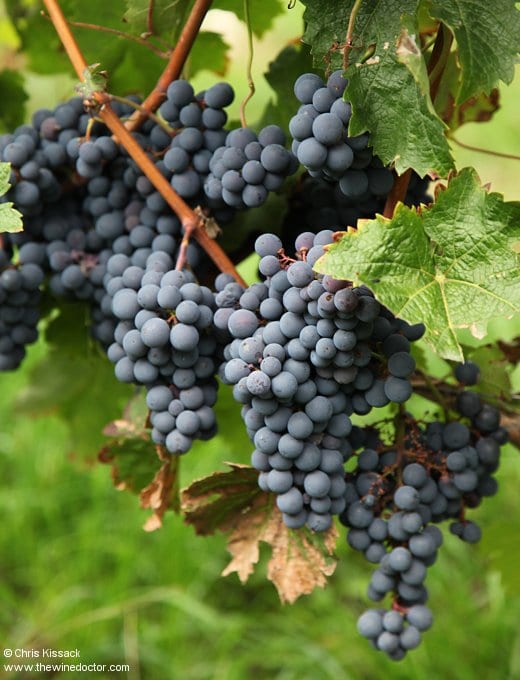
- Harvest timing: winemakers must inspect and taste the fruit on a regular basis leading up to harvest. Timing of harvest is paramount to have a riper richer more balanced style of Cabernet Franc - harvest should ideally commence when fruit and phenolic ripeness are optimum. In warm years flavour ripeness will come earlier than phenolic ripeness and in this instance timing of harvest should be linked to flavour ripeness and not phenolic ripeness to ensure that typical fruit flavours of the variety and region are preserved.
- Winemaking techniques to be employed to make more balanced wines should work to preserve fruit, minimise phenolic extraction, and achieve stability during elevage and at bottling.
Summary of Recommendation
The project provides interested growers with specific guidance from Sam Harrop MW on techniques to be employed during harvest and fermentation.
- On a normal harvest day, fruit should be in the cellar before 11:00am when the ambient temperatures are still relatively cool.
- Consider the use of triage to remove dried berries.
- Avoid using the crushers - this will ensure the wines have less bitterness and more ripe fruit flavours.
- Pre-fermentation maceration is a technique used a lot with Cabernet Franc and it can be used to good effect if the fruit is ripe enough. Too often it is used on green unripe fruit. In this instance the process merely enhances the unripe, herbaceous notes and this should be avoided if the winemaker cannot guarantee the fruit is ripe enough at harvest.
- Producers to avoid spontaneous fermentation and to inoculate with select yeast strains to ensure a healthy and complete fermentation. Trials were carried out at one producer with a yeast strain that minimises the herbaceous flavours drawn from the fruit during fermentation.
- If the fruit is ripe, a fermentation temperature of 24°C of the juice to enhance the primary fruit characters through definition. If the fruit is green a fermentation temperature of 26-28°C.
- By checking the temperature 2 x a day you will get better control over fermentation.
- Ease off on the timing and frequency of remontage – be gentle.
- Consider using more délestage if tannins are ripe certainly after 2 days of fermentation.
- Consider each parcel separately depending on the quality of the fruit during the extraction process.
- Wine should be kept at 20°C during post fermentation maceration to aid the extraction process.
- Check sulphur levels on wines 1 x every two weeks, post malolactic fermentation (MLF) and adjust to keep levels at 25ppm to avoid MLF and oxidation.
- For hygiene and quality use a lactic acid bacteria culture to start MLF. Keep the temperature at 20°C and monitor the MLF closely. As soon as the MLF is complete add sulphur dioxide to ensure the wines do not oxidise.
- With ripe fruit consider pressing a small percentage of production into barrels and allow wines to carry out their MLF in barrel for added complexity and texture.
- Do not blend wines too early. Keep separate to give more flexibility at blending.
- Check sulphur dioxide levels in tank and barrel frequently after MLF.
- Ensure no lag between primary and secondary fermentation by inoculating with appropriate culture. This will minimize the chance of rogue yeast and bacteria activity and limit the production of off flavours and Brettanomyces will be detected early.
- Only consider oak use if the fruit is ripe enough both in sugars, flavour and body.
- Pad filter wines a week before bottling. Put through a membrane filter 1 micron at bottling.
This concludes my summary of the Cabernet Franc Project protocol. For more on the project, including my tasting notes on the wines, follow these links:
- See part one for my introduction and tasting notes.
- See part three for more tasting notes.
