Home > Vintages and Regions > Loire > Loire 2003 > Tasting, September 2011

Loire 2003: Tasting, September 2011

Loire 2003

Loire 2003

Revisits

Tasting, September 2011

This tasting of wines from the 2003 vintage at eight years of age does not, unfortunately, take in every region and every style. As usual my focus is on Anjou, Saumur and Touraine, the true heart of the Loire, featuring wines from some of the Loire's leading vignerons, including Bernard Fouquet of Domaine des Aubuisières, François Pinon, Bernard Baudry, Claude Papin of Château Pierre-Bise and Philippe Foreau, not to mention the Foucault brothers of Clos Rougeard. There are also examples from what I believe are 'old favourites' for many who like to drink their way up and down the Loire, from Couly-Dutheil and Pierre Jacques Druet.

So this is not a bad selection; not comprehensive by any means, but enough to afford us a superficial feel for the vintage at the very least. Naturally I would have been more content if I could offer some report from each and every Loire region, even if it were just on one or two wines, but I am unable to do so. My sole representative from Muscadet is the Sélection de Maxime from Bruno Cormerais, a wine that brings together prolonged oak aging and Melon de Bourgogne, a combination that rarely works well in my experience. Having said that it seemed to all marry up quite nicely here, but the overall effect was spoiled by a background trace of oxidation.

Loire 2003

As for the central appellations of Sancerre, Pouilly-Fumé and so on, I have nothing to offer in this department. I have to admit, however, that I won't lose too much sleep over this. The vintage was not a good one across all of France for dry white styles, and my experience of rather soupy, blowsy wines includes encounters with wines from - off the top of my head - Savennières (including the Baumard Clos du Papillon, tasted here), Meursault and a number of other Burgundy appellations, Alsace, Pessac-Léognan and Champagne. None, in my opinion, have covered themselves in glory. Sweeter styles cope better, perhaps because the acidity is concentrated a little as the fruit dehydrates, and red wines seem to be more tolerant of lower acid levels, although in neither case are the wines immune. Happily for me, most of the wines tasted here showed very well indeed. (21/9/11)
Loire 2003: Tasting Notes

These wines were tasted in September 2011. Click to locate stockists.

Nantais

Bruno Cormerais Muscadet Sèvre et Maine La Sélection de Maxime 2003: Five years in oak here; this is not as evident on the nose as I suspected it might be though, as there isn't a wealth of woody aromas to be found here. There is a light layer of golden fruits, along with a wilder, more gamey note which may well be related to the oak, but it is not very prominent. The palate follows on with a broad, dry, polished layer of dry fruit with a little oxidative hint to it. There is grip, an exciting tingle of acidity, but also nuances of nutty, earthy, dried wood notes from the oxidation. Certainly interesting, for once the oak seems to work well with this variety, when in my limited experience the opposite is usually true. It is just that little trace of oxidation that detracts. 14/20

Anjou & Saumur

A lone representative from Savennières.

Domaine des Baumard Savennières Clos du Papillon 2003: This vintage has a slightly tinny nose at the moment, paradoxically accompanied by some rather fat fruit. It is not that expressive in truth. In keeping with the latter of these aromatic elements the palate has a slightly fat feel to it, not entirely unexpected, although it certainly doesn't stray into blowsiness. Rich, creamy, fruit-rich with low-level tangible acidity, this lacks the definition or structure I am looking for in this cuvée. A vintage effect, for sure. 14.5/20

Wines from Aubance, Layon & Chaume.

Domaine des Deux Moulins Coteaux de l'Aubance 2003: Rather an understated, pale gold but shimmering hue here. The nose matches this rather subdued appearance, showing more candied and fresh tropical fruit with a subtle sweetness in the background nicely countered by a lemon lift. The nose is also rather smoky and minerally, an effect bolstered by a matchsticky element of flinty reduction; the overt botrytis noted last time seems less apparent this time, showing through as fresh quince and pear. Good substance on the palate, a moderate sweetness and grip, but with a fresh and grainy character, and although the nose doesn't suggest it there is real depth and a sweet-savoury honeyed texture here. Not an overly dense or prodigious wine, but certainly polished and of some substance through the middle and finish, which is fresh, charismatic, grainy and long. 17/20

Château Pierre Bise Chaume Premier Cru des Coteaux du Layon 2003: There is a moderate orange-gold tinge to the appearance of this wine. The nose carries aromas of peach and tangerine, and suggests a concentrated richness. Alongside come nuances of quince, herbal tea and orange fruit, all very captivating yet also rich, contrasting nicely against the subtle bitterness of it all, suggesting structure not simple sweetness. The palate shows a very fresh yet mellifluous style, quickly moving into a more liquorous character. There is lovely breadth and character, a finely textured palate, beautifully balanced grippy-orange pith, and a fine substance, tender and rich. An impressive wine here, with plenty of definition, acid and phenolic grip, although there is still a strong focus on its pure sweetness, up until the end when there is a minerally flourish giving more contrast and interest Very fine, and very long too. Super. 17.5/20

Domaine des Baumard Quarts de Chaume 2003: Not the most impressive hue in the glass, the wine showing a gentle, shimmering, golden hue. Nevertheless, aromatically this is very enticing, mainly because of the trademark quartzy minerality which is present here, although in perhaps a lower level than can be found in some vintages, and this is compensated for by an evolved caramelly-biscuity richness which rather calls to mind the sweetness of the 2001. On the palate this all shines through very convincingly, the immediate and gentle sweetness nicely framed by the acidity and then the grip of the wine, the framework taking on a very firm, sharp, knapped-flint edge. There is a soft, mellifluous, rich, sweet and almost oily substance to the wine, but the structural elements balance this out with ease, so on the palate the wine seems, despite the sweet fruit-pastille intensity, quite lively and vivacious. In the finish it shows good length, and those caramelly notes return, together with elements of barley sugar, citrus zest and all the sharp, quartzy minerals I seek out. This is still a very young wine, but it is full of potential. 18.5/20

A lone representative from Saumur-Champigny.

Clos Rougeard Saumur-Champigny Le Bourg 2003: Not a particularly deep colour here, a rather bright brick red towards the edge, but a fresher red hue at its core. Aromatically it seems rather sullen at first, opening out with time to reveal some elements of roasted fruit, celery seed, dried coffee grounds and even more earthy elements, subtly redolent of old school desks. Quite fleshy and rich on entry, full but supple, and immediately it seems to typify the vintage. Then, although through the middle it shows a more elegant silky upper surface, it is clear that underneath this lies quite a full, richly endowed wine, and then a further layer down there hides a seam of grainy, almost spicy tannins. This structure builds through the middle, and it is happily balanced out by fresh acidity coming up from beneath the wine, giving the finish a vigorous, energetic feel. A lovely wine, long but full and rich. Although there has been some marked development in this wine over the past year or two, this nevertheless certainly warrants a lot more time in the cellar. 18.5/20

Touraine

A septet of Bourgueil and Chinon.

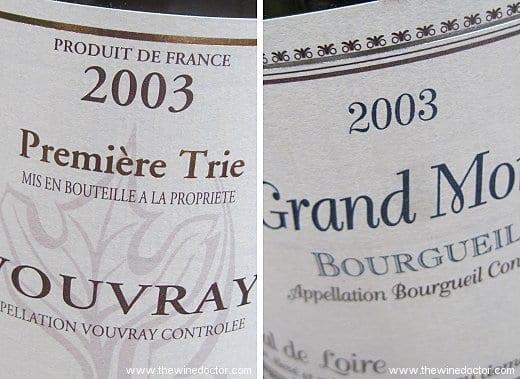
Pierre Jacques Druet Bourgueil Grand Mont 2003: A very dark, dusty-matt red-black hue. The nose is very closed down and its character is very primary, dense fruit, but work hard at it and you can coax a stony perfume from it, twisted with notes of dark plum skins. It is very solid from the start and remains so through the midpalate, relaxing as it goes, revealing a good flesh with lots of svelte, creamy tannins and plenty of tangible structure. Full, ripe, rich, with a minty edge to the withdrawn fruit character. Best of all a finely crafted finish, followed by a lingering coating of tannins. Super wine, but dense and ungiving at present. This has great potential for the cellar. With that in mind I left some 24 hours; it developed into a fine-boned, fresh and sappy example of Bourgueil. Super wine. 18/20

Couly-Dutheil Chinon La Chatelières 2003: A cuvée from sand and gravel terroirs, intended for unfussy drinking and not really for cellaring. So obviously I cellared some. A fading red hue in the glass, although no overt tones of maturity at all. The nose suggests slightly sweet, perfumed fruit, very floral with suggestions of violets and primroses against a chalky background. The palate carries plenty of floral fruit still, chalky and minerally, with a moderate substance cut through with a little touch of grit which gives a welcome backbone behind the slightly soft, oily fruit. It's the perfume I find most appealing. I'm not sure this is really any better than it was a few years ago, nor is it living up to any suggestion that it might do well in the cellar - perhaps reflecting the sandy terroir - but it certainly makes an attractive easy-going red. 15/20

Couly-Dutheil Chinon Clos de l'Echo 2003: Big chunks of potassium tartrate stained purple here, so a wine that benefits from decanting. Still deep and darkly coloured, although the nose has certainly progressed, the fruit more certain, having narrowed down into a smoky raspberry and cranberry character, with notes of green peppercorns and the sweet richness of bramble fruit forming a very subtle vein underneath the drier fruit closer to the surface. It is well framed rather than sweet or soft though, firm, lightly mineral, brightly-edged. A very appealing and supple character at the start of the palate, although there is a great polished style to it as well. Stony, peppercorny, really quite dry in terms of structured, a character coming from the ripely tannic structure. Bright, balanced and fresh, this is delicious now but still very youthful and full of potential. Lovely, but with years and years ahead of it. 18/20

Couly-Dutheil Chinon Clos de l'Echo Crescendo 2003: More big chunks of stained potassium tartrate here. Like the straight Clos de l'Echo cuvée a very rich, solid, deeply coloured wine here, although with a gently maturing tinge. The nose is very different, as whereas the preceding wine was dominated by wonderful Cabernet Franc fruit this wine currently shows an incisive layer of charcoal and sooty smoke, in part related to oak, in part perhaps reflecting the wines bigger, more tannic structure. There are little nuances of fruit also, with a peppercorn trace, but this largely hides behind a very dark, concentrated, beetroot- and earth-tinged cloak. A very fine substance on the palate though, coolly composed like its companion, showing lovely grip and a fine backbone, but with a much firmer character though the middle, the grip here really tightening up. The tannic structure dominates, although there is plenty of substance to carry it along, just the fruit is well hidden at present. I think this wine would annoy purists, but I think it is brimming with potential, some of which doesn't show through as it has closed down more solidly; it may never give the hit that some desire from Chinon, but I think it will be a lovely wine given appropriate time in the cellar, perhaps another ten years. A big, tannic and very long finish only reinforces this belief. 18.5/20

Bernard Baudry Chinon Le Clos Guillot 2003: I can't believe it is five years since I last opened one of these; fortunately this cuvée has progressed very gradually and in a very positive fashion over the years it seems. Still a very dark and dusty hue, red-black, certainly nothing to suggest maturity. And the nose is delightful, carrying notes that hark back to my last tasting, elements of charcoal and soot and scents of black raspberry, black olive with a fleeting, subtle toffee-crystal twist. The palate is just great, beautifully defined, fresh and yet with a cool, defined, savoury substance, buoyed along with plenty of acidity. Great vibrant and vigorous presence in the mouth, succulent and brimming with cherry skin and cranberry. And at the end, a residual of blackness, perfume and a seam of fine, swirling, gritty-sooty tannin. And it is long, too. This is great stuff; if you have some, open one as this is just lovely now, but don't drink it all. This will go for years yet. 18/20

Bernard Baudry Chinon La Croix Buisée 2003: Still rather a dense colour here, vibrant and youthful, fairly concentrated even out at the rim. It only takes 30 minutes or so to open up although it doesn't relax to the point where you would even begin to think this will be ready yet. It still has some primary fruit, dark cherry, with a sweet, smoky, sooty depth of character behind it. Polished but firm and sweetly dense at the start, for a Chinon at least, showing more welcome edge and definition through the middle although still with a firm, robust, broadening style. Towards the finish it seems more aggressive in its character, any earlier suggestions of perfume fading behind a tangible substance and a layer of gritty tannins. Nice acidity despite the warm vintage although it is the tannin in particular that binds up the finish. Approachable thanks to all that fruit and texture, but right now this is only for those wishing to experiment I think. For those looking for real pleasure, this isn't showing even a fraction of its true elegant potential as yet, and needs another 3-5 years at least. Leave well alone. 17.5-18/20

Olga Raffault Chinon Les Picasses 2003: Richly coloured, dark, with a little dustiness but no real maturity here. An interesting nose, rich in fruit, with a roasted confit style reflecting the vintage, also little notes of floral perfume and a strong seam of aniseed which I rather like. The fruit doesn't have a plush or generous style at all, rather it is dark, hard, laced with green pepper and particles of soot. Quite some flesh on entry, although this is in no way a plump or plush wine, showing through the middle a much harder character. The fruit is dry and bitter, with notes of cranberry and pepper, and a bitter finish showing rather a lot of grip too. Just a touch of oil to the texture which detracts, but there is plenty of grip and acid to underpin it all. Really good, and classically styled, but perhaps not at the level I rated it last time - three years ago. 17/20

The sweeter side of Vouvray.

François Pinon Vouvray Premier Trie 2003: From a 500 ml bottle. This wine has a lovely mid-gold hue, with no shortage of colour although it is not overly rich. The nose has a very pure, almost ethereal character, enriched with notes of barley sugar, cut with smoke and stone, all in a very broad and expansive style. The palate starts off pure and yet fleshy, and then reveals a richer character, before showing through the midpalate an amazing balance, with richness and a bright and lifted purity. There is a remarkable sweet and tropical fruit vivacity to it, with a creamy, apricot- and sage-tinged character. Overall this is very stylish, with a fine and very linear structure, and delicate but precise acidity. Fine stuff indeed. 18/20

Domaine des Aubuisières Vouvray Cuvée Alexandre Moelleux 2003: I have an inkling that my last bottle of this showed a much richer, bronzed hue, in keeping with the rich reputation of the vintage. This time, although rich and yellow-golden, this wine does not have the burnished suggestion I seem to recall. This fresher character seems to run through the nose and palate of the wine too, the aromas lively and tear-jerking, the palate broad and enthralling. Aromatically, there are notes of mango, candied pineapple, sweetly intense pear and melon, all imbued with honeyed richness, with a firm, sweet, minerally suggestion, nuanced with rich, biscuity elements. Beautifully seductive on the palate, polished and carrying much sweetness, and what I find here that I have not really noted in previous vintages is extreme elegance, a lifted and fresh element along with the intense, solid, lightly minerally and lightly crunchy. It is a vibrant wine, with tinges of orange citrus cutting through the baklava pastries, warm and honey-drizzled, sprinkled with pistachio and almond. The substance is impressive, the acidity admittedly taking a back seat, as previously noted, but it remains fresh and with good grip. I previously questioned this wine's future; no more. This could go for decades I think. Beautiful, very long, bordering on ethereal, seemingly now transcending the vintage's style. 19/20

Philippe Foreau Vouvray Moelleux 2003: This was painfully youthful, but singing all the same. Aromatically it kicks off with a little matchsticky reduction but this soon blows off, the nose then dominated by a crystalline fruit character that I find hauntingly entrancing. There are elements of quince and herbal tea, but it is the intense minerality that comes to the fore that really grabs my attention. Behind this are notes of ripe stone fruit and also a ripe citric lift to counter the sweetness, but it is the minerals and crystallised fruit that dominate. If you could condense some straw-tinged fruit down to an easily fractured flaky crystal, pepper it with orange zest and then sprinkle it with tinges of acacia and almond, this wine is what you would get. What it promises on the nose it delivers on the palate, leaving no room for disappointment; the style here is bright, minerally, crystalline and although it has a slightly solid feel to the midpalate perhaps in keeping with a warmer vintage, there is also superb freshness and tingling acidity, and given time I think this will come good. In fact, I think it will be truly stunning. A superb wine that is quintessentially Vouvray; there is no other variety, region or indeed domaine which could produce a wine like this. 18.5/20

Philippe Foreau Vouvray Moelleux Réserve 2003: I opened this with some trepidation, as the 2003 Moelleux Réserve brought to a tasting with Eric LeVine at the Ledbury 18 months ago was strangely disappointing. No such concern was necessary; in the glass it starts off with a beautiful orange-gold hue; it is not as deeply coloured as the 2003 Cuvée Alexandre tasted alongside though. Nevertheless, the aromas are captivating nose, oranges and blossom, mixed with almond paste, honey and sweet pastry. Overall, it is - quite simply - amazing. The palate is just as beautiful as the nose, broadening out here, with a sweet and expansive character, and yet it is also immediately elegant. There is superb freshness, a gentle acidity coming through, not overt or firm in its presence, but it is finely balanced, giving this wine a dramatically harmonious and complete feel on palate, just before all the delightful nutty and orange blossom notes wash in, swamping the senses with exotic complexities such as mango, straw, yellow plum, rôti fruit, minerals and white pepper. This has such depth and complexity! Stunning. 19/20